The Two-Megawatt Lane: Norway's Prequalified Reserve Market and Hydro's Funded Head Start
10 September 2026 · 8 min read · Auranova Ventures
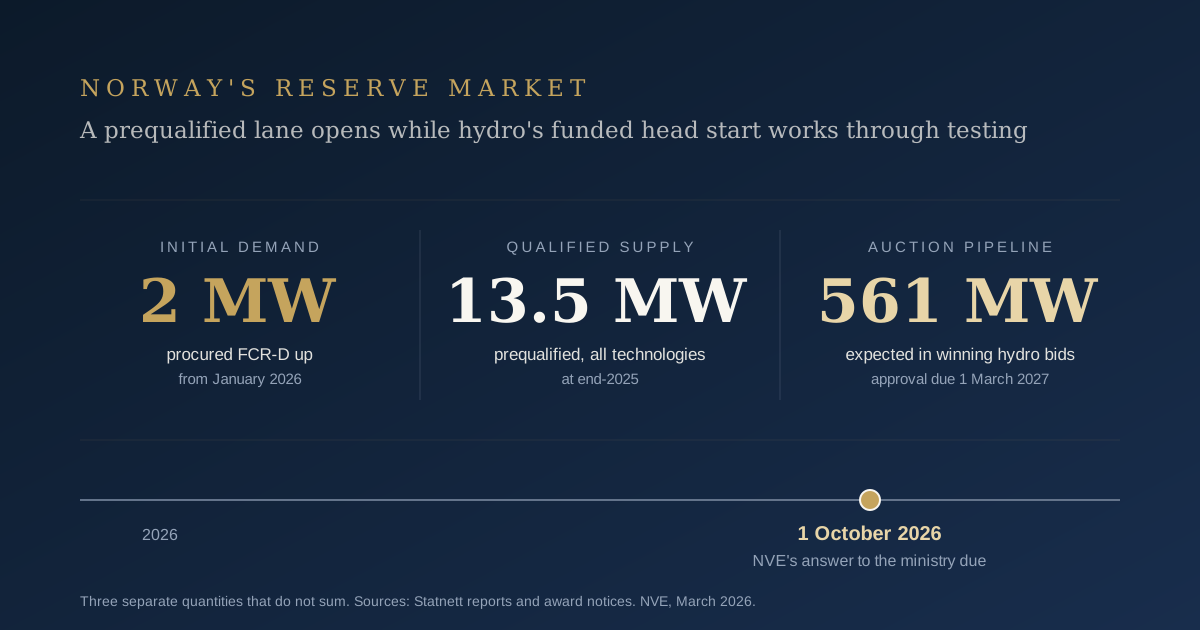
In January Statnett opened Norway's first year-round auction lane for FCR-D up, frequency containment reserve for disturbances, the fast product that arrests a falling grid frequency, restricted to prequalified assets, those tested and admitted to the product. Opening volume: 2 MW. Since September 2025 Statnett has also awarded funding toward prequalifying an expected 561 MW of FCR-D up. The award lists name hydropower generators and no batteries. Anyone reading Norway as the Nordics' last open battery market should read those numbers together.
The development
Three Norwegian moves frame the battery year, plus one Nordic change this month.
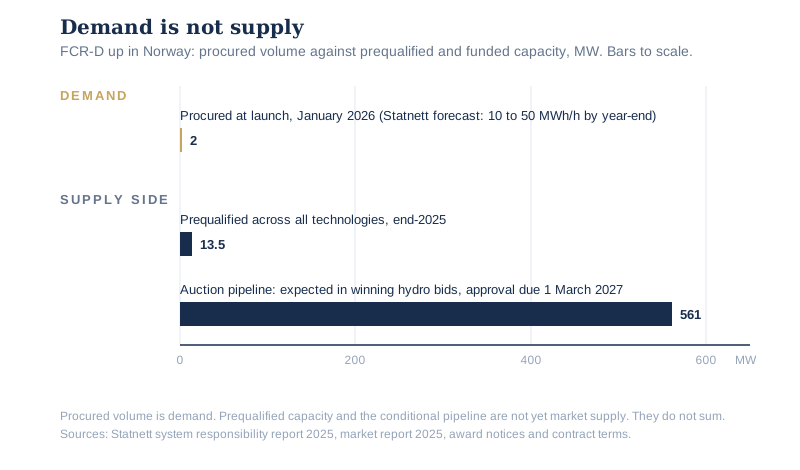
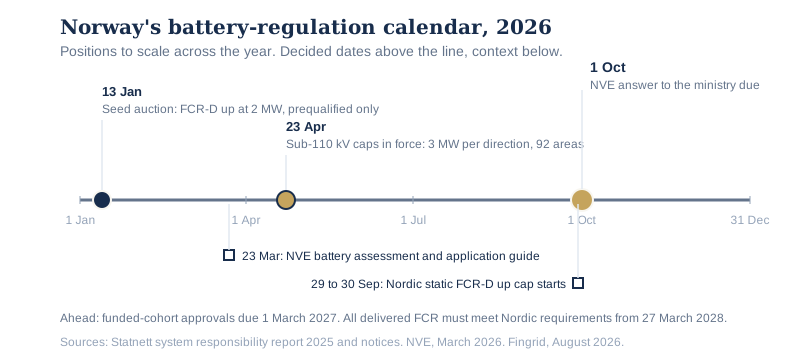
First, the lane. From January 2026 Statnett, the state transmission system operator, buys FCR-D up in a day-ahead auction open only to prequalified assets, all year, starting at 2 MW with first delivery on 13 January. Statnett set the opening volume low because little prequalified capacity existed and will review it at least quarterly. Its April 2026 market report expects the purchase to grow through 2026 from 2 MWh/h at launch to roughly 10 to 50 MWh/h toward year-end, with 2027 explicitly uncertain. At the end of 2025, per Statnett's system responsibility report, 13.5 MW of FCR-D up was prequalified across all technologies. From 27 March 2028, all FCR delivered in Norway must meet the Nordic technical requirements; until then the rest of the obligation stays with base delivery.
Second, the funded head start. To move incumbent capacity through testing, Statnett ran two prequalification-support auctions, each with a 25 million kroner frame. The awards, published 4 September 2025 and 2 February 2026, cover 30 FCR units with an expected 561 MW of FCR-D up in the winning bids. The contract terms make this a pipeline, not a delivery: approval is due by 1 March 2027 and payment covers only capacity actually approved, between 60 and 120 per cent of the bid. A unit that fails prequalification is paid nothing. The award lists name hydropower generators (Kvilldal, Vemork, Nedre Vinstra, Sy-Sima and their peers) and no batteries.
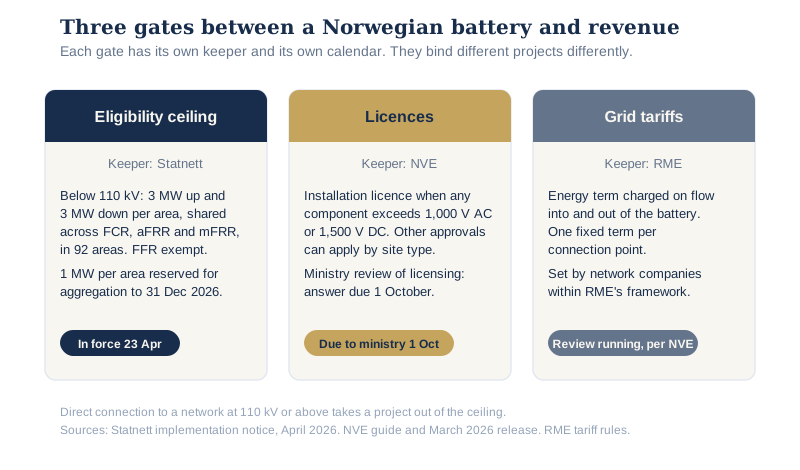
Third, the ceiling. On 23 April 2026 Statnett capped prequalification for regulating objects, the market's word for a controllable asset, in grids below 110 kV, meaning nominal voltage of 66 kV and lower. Each of 92 capacity areas, sub-areas of the regional grid, gets a ceiling of 3 MW up and 3 MW down on total prequalified volume, shared across FCR and the restoration reserves aFRR and mFRR, the slower automatic and manual products that relieve the fast ones over minutes. FFR, the very short burst product, sits outside the capped products. So does flexibility in distribution grids connected directly to networks at 110 kV or above. Until 31 December 2026, 1 MW of each ceiling is reserved for aggregated groups of sub-1 MW resources. Statnett can refuse applications below the ceiling where the local grid requires it and says caps can move in either direction. The stated reason is observability: most of the sub-110 kV network is not in Statnett's network model.
Fourth, the rulebook. In March NVE, the directorate that licenses energy infrastructure, published fact sheets on batteries in the power system and an application guide: an installation licence under the Energy Act is required when any component exceeds 1,000 V AC or 1,500 V DC, though other approvals can still apply by site type. The Ministry of Energy has instructed NVE to review the purpose of and the need for licensing battery installations; NVE's answer is due at the ministry by 1 October 2026. RME, the energy regulator organised as an independent authority within NVE, is reviewing battery-related regulations in parallel. RME's current tariff rule: the energy term, the per-kWh part of the grid fee, is charged on the flow both into and out of the battery, with one fixed term per connection point. The Nordic change: from 29 September, with delivery from 30 September, the four Nordic operators cap purchases of static FCR-D up, the class delivered with stepwise rather than continuous response; resources prequalified as dynamic sit outside that cap. We covered the quotas separately.
What it actually means
Norway has long procured reserves, so be precise about what is new. Its FCR needs are met mostly outside competition: producers, in practice the hydro fleet, deliver primary reserve as a mandatory base delivery, grunnleveranse, decided by the system operator. Statnett's report records a 231 MW FCR-N market need in 2025 (FCR-N is the sibling product for normal frequency swings), summer-only purchases of 100 MW FCR-D up since 2023 when base delivery falls short and no Nordic-level prequalification behind any capacity bought in 2025. What is new in 2026 is a year-round lane where only capacity meeting the Nordic technical requirements can sell. That is the lane a battery would live in.
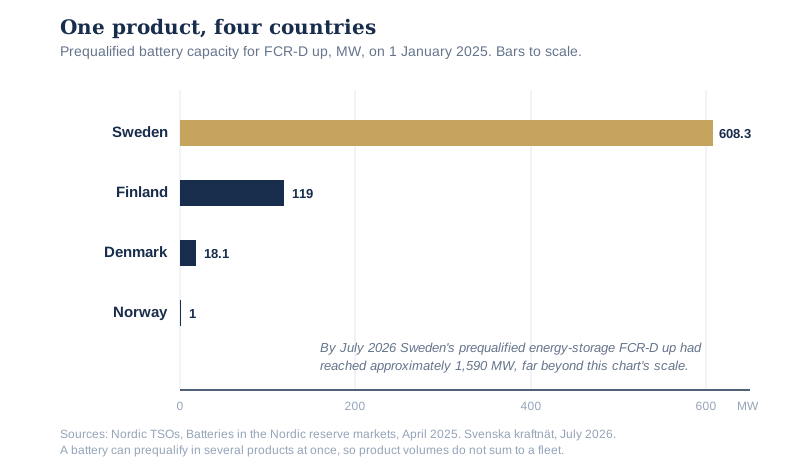
Keep the quantities apart; they mean different things. Competitive demand in the lane opened at 2 MW and Statnett's own forecast takes it to only 10 to 50 MWh/h by year-end. Qualified capacity stood at 13.5 MW at end-2025. The funded pipeline is an expected 561 MW with approval due by 1 March 2027, conditional on each unit passing its tests. Our read: if even a fraction of that pipeline converts, a battery entering this lane will compete with newly qualified incumbent hydro for volumes Statnett sets one review at a time. When we model Norwegian entry we therefore treat procured volume, not qualified capacity, as the binding constraint. We also note there is no complete public Norwegian clearing-price series for the new lane yet. Neighbouring markets are context, not forecast: Svenska kraftnät reported approximately 1,590 MW of energy storage prequalified for FCR-D up by July 2026, a different market with different fundamentals.
The April ceiling bounds the small-scale route in. Our arithmetic on Statnett's inputs: 92 areas times 3 MW is a theoretical maximum of 276 MW per direction of prequalifiable sub-110 kV flexibility, shared across products, with 184 MW outside the aggregation reservation until year-end. Actual headroom is lower: existing approvals count against each local ceiling and Statnett can refuse below it. This is an eligibility bound, not a market size.
One caution across borders: prequalified capacity is neither procured capacity nor revenue. The Nordic TSOs warn in their joint battery report that one battery can prequalify in several products and that qualification does not mean a resource is active in a market.
Who feels it and how differently
Developers below 110 kV carry the ceiling. Standalone batteries on regional grids, solar hybrids and aggregation portfolios share 3 MW of eligibility per area, minus the reserved megawatt until year-end. Confirming actual area headroom with Statnett and the network company belongs before land and connection spend.
Developers at 110 kV and above (or connecting directly to such networks) sit outside the ceiling. Their questions are the installation licence (triggered by any high-voltage component) and whatever the licensing review changes. Lighter or merely clearer licensing decides how much pipeline moves.
Network companies sit on the ceiling's other side: Statnett is limiting what it cannot observe in their grids, so distribution-grid data sharing shapes every future cap adjustment.
Investors should watch three separate series, not one: procured volume at each quarterly review, prequalified totals and the funded hydro cohort as approvals land through to March 2027. The first is demand. The other two are potential competing supply.
For policymakers the live questions are already visible: what evidence would let the 3 MW ceilings rise and how licensing should interact with connection processing.
What to do about it
Watch the 1 October deadline. NVE owes the ministry its answer on battery licensing that day; the question that matters is whether licensing gets lighter, clearer or neither.
For sub-110 kV sites, verify capacity-area headroom before committing spend and check whether a direct connection to a network at 110 kV or above lifts the project out of the ceiling.
Track demand and supply separately. Procured FCR-D up volume is the demand series. Prequalified totals and the funded cohort's approvals are the potential-supply series. An entry case that ignores the second is underwriting against the wrong curve.
Put the two structural dates in the model as what they are: funded-cohort approvals due by 1 March 2027 and the 27 March 2028 switch after which all delivered FCR must meet the Nordic requirements.
The market being written
Battery markets get repriced by rules before they are repriced by revenue: Sweden's as FCR-D clearing prices fell year after year, Finland's when Fingrid moved 2027 FCR procurement to the hourly market. Norway is writing its rules now, in public, with dates attached. This is the kind of question we at Auranova Ventures work through with developers and investors across the Nordics, Baltics and wider Europe, separating demand from supply and option value from build value before capital moves. If Norway sits on your map, reply and we will compare notes on what the 1 October answer needs to say.
When NVE hands the ministry its answer on 1 October, which side of the 110 kV line will your first Norwegian megawatts sit on?
Sources
- Statnett: system responsibility report 2025 (FCR transition, base delivery, prequalified volumes)
- Statnett: market report, Kraftmarkedsaret 2025 (FCR-D up procurement forecast for 2026)
- Statnett: primary reserves, FCR-D up auction reserved for prequalified assets in 2026
- Statnett: FCR-D up procurement from January 2026
- Statnett: FCR prequalification support auction awards, September 2025
- Statnett: FCR prequalification support auction awards, February 2026
- Statnett: contract terms for the FCR prequalification support auction
- Statnett: prequalification limits for regulating objects in grids below 110 kV
- NVE: batteries take a bigger role in the power sector, March 2026
- NVE: application guide for battery installations
- RME: grid tariff rules for grid-connected batteries
- Fingrid: updated implementation plan for the static FCR-D up volume limitation
- Fingrid: FCR procurement focused to the hourly market in 2027
- Nordic TSOs: Batteries in the Nordic reserve markets, April 2025
- Svenska kraftnät: prequalified reserve capacity by product, July 2026