Every Bid Names Its Floor: Nordic Balancing Capacity Auctions Flip Their Default in November
17 September 2026 · 8 min read · Auranova Ventures
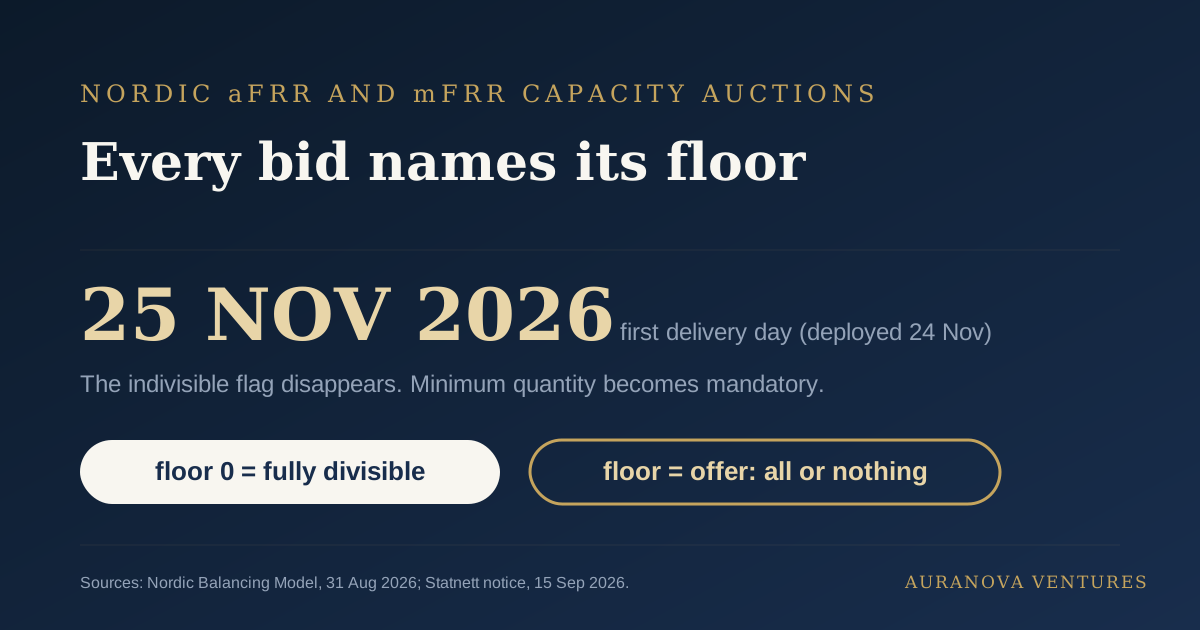
Since 15 September, a capacity bid submitted to the Nordic reserve test environment without a minimum quantity comes back rejected. On 24 November the change reaches production and from the 25 November delivery day it binds: the indivisible flag disappears from the Nordic capacity auctions for aFRR and mFRR (the automatic and the manual frequency restoration reserves) and every bid must name the smallest acceptance it will take. The all-or-nothing bid survives. What dies is submitting one without deciding to.
The development
The final date was set on 31 August by the Nordic Balancing Model programme, the market-development vehicle of the four Nordic transmission system operators (TSOs) Svenska kraftnät, Fingrid, Statnett and Energinet, after a March notice announced the change for autumn. It applies to the balancing capacity auctions for both reserves: aFRR works to restore grid frequency toward 50 hertz on an automatic signal; mFRR, the slower counterpart, relieves it (the m stands for manual, though Nordic activation was automated in March 2025). A balancing capacity market pays a provider for standing ready whether or not the reserve is activated. That standby income is a core layer of the revenue stacks we model for Nordic batteries.
Both auctions clear on one platform, the Nordic Market Management System (Nordic MMS). The aFRR auction has cleared as a single Nordic market since 7 December 2022, launched by Svenska kraftnät, Statnett and Energinet; Finland joined and trading began on 24 December 2022. It spans the bidding zones (the price areas a market clears over) of Norway, Sweden and Finland plus the DK2 zone in eastern Denmark; the platform also runs a local aFRR auction for Denmark's DK1 zone with no cross-border exchange, per the December 2024 market handbook. For mFRR, Fingrid, Svenska kraftnät and Energinet merged their national capacity markets into one trilateral auction in November 2024, while Norway procures on the common platform without currently sharing mFRR capacity across borders, per Statnett's 2026 balancing report. One platform, so the change lands everywhere at once.
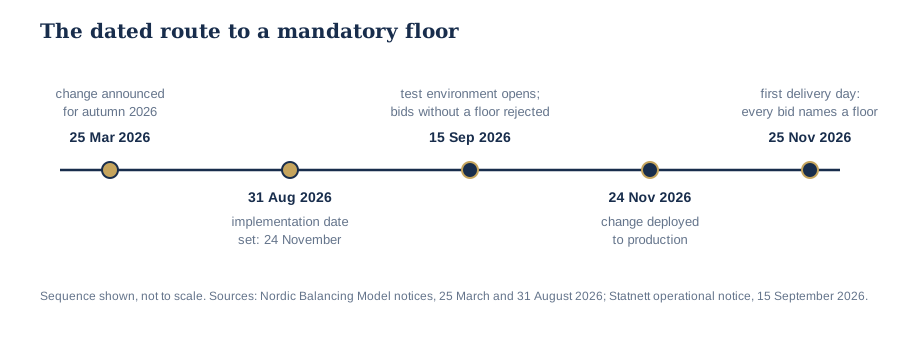
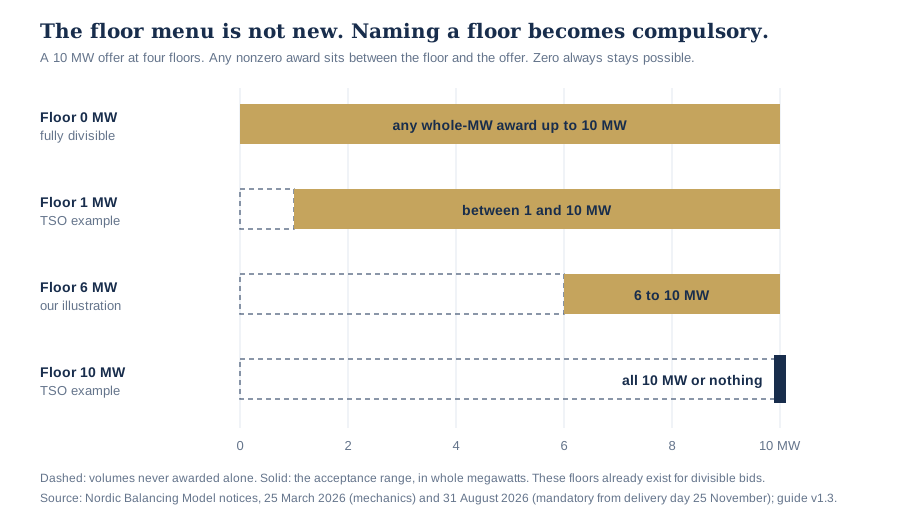
The mechanics sit in the implementation guide (version 1.3, 19 March 2026). To be precise about what is new: the minimum quantity field is not. Divisible bids carry one today. An accepted bid already clears anywhere between that floor and its offered volume or is rejected whole. What changes on 25 November is the default and the obligation. The indivisible flag is removed, the floor becomes mandatory for every bid and indivisibility becomes something a bidder writes as a number, by setting the floor equal to the offer. A floor of zero makes a bid fully divisible. The floor may not exceed 50 megawatts, the same cap the old rules placed on an indivisible bid's whole volume. On 15 September the TSOs opened the test environment. Statnett's operational notice that day spells out the consequence: bids submitted without a minimum quantity are rejected.
What it actually means
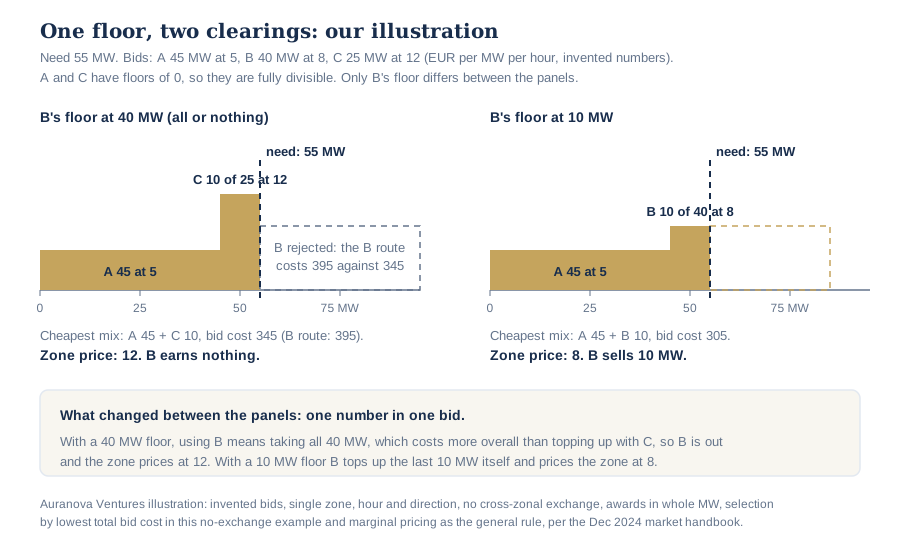
Why force the choice? In the March notice the TSOs are blunt: bids today "are by default indivisible if no attributes are utilized", which "causes a number of indivisible bids, that are in reality not indivisible". Doing nothing produced an all-or-nothing bid. The reform aims at that accident, not at the honest lump. An all-or-nothing bid is a lump the clearing algorithm must take whole: if the auction needs 15 more megawatts and the cheapest remaining bid is a 40 MW lump (our illustration), the optimiser must buy capacity it does not need or pay more elsewhere for volume that fits. Prices here are marginal: as the general rule each bidding zone, hour and direction pays the most expensive selected bid, with cross-zonal exchange and complex bid types complicating the edges. So a lump is not private; it can move the price every provider in that zone, hour and direction is paid.
The Nordics have paid tuition on indivisible bids before. In the mFRR energy activation market, the separate auction pricing actual activation, indivisible bids at the price margin helped push clearing prices into bidding zones they should not have reached. Energinet, Svenska kraftnät and Statnett screened the results and corrected flagged periods manually from go-live; the TSOs deployed an algorithm fix on 25 November 2025 and stopped the corrections on 8 December. The parallel is not exact, since that flaw sat in price formation while bid selection stayed correct. But the lesson repeats: indivisibility at the margin carries prices further than one bid. November shrinks its accidental share at the source.
How much shrinks is the open question. Honesty requires the counterargument: a careful desk that already set its floors deliberately changes nothing in November except a submission field. The TSO notices we cite do not quantify the split between accidental and intended indivisibility, so the size of the prize is not public. Our read is conditional: to the extent the old default was doing the deciding, the optimiser gains room and acceptance patterns and marginal prices can move. If most of today's indivisibility is deliberate, November is hygiene and clearing barely moves. Until the first weeks of results settle it, the safe thesis is operational: the deadline is real, the economics are contingent.
One quirk deserves attention before anyone rebuilds templates. The floor is set once per bid and applies to every hour the bid covers, per the implementation guide. A bid whose offered volume varies hour by hour can therefore no longer be indivisible in each hour, because one floor cannot equal several different offers. The TSOs' answer is to split such strategies into several flat bids of constant volume; fully indivisible bids with variable volumes across hours are, in the guide's words, no longer supported.
Who is affected and how differently
For battery owners the change asks little of the machines. A battery can deliver a partial award as easily as a full one, which is why we treat divisibility as a structural advantage of the technology in our revenue-stack work; the mandatory floor mostly turns that flexibility into an explicit choice. The desk-side work of testing and template changes is real. The market exposure is indirect and unquantified: if a meaningful share of the pool's lumps was accidental, clearing patterns move; if not, nothing changes but the submission format.
For providers whose units cannot honour small partial awards, the floor carries engineering content. The honest number is the smallest award the unit can actually deliver as reserve, related to but not the same as a generator's minimum stable output. It must fit under the 50 MW cap. Hour-shaped indivisible strategies must be rebuilt as flat split bids.
For aggregators and trading desks this is first an engineering deadline. The mandatory field lands in every submission channel at once: manual entry, file upload and ECP, the Energy Communication Platform used for machine-to-machine submission. The TSOs urge testing through each channel used. After 24 November a submission that omits the floor is not a worse bid but a rejected one. A capacity auction missed is standby revenue that never existed.
For the TSOs it reads to us as groundwork: the September 2025 consultation follow-up kept bid formats unchanged while holding open future design work. Cleaner divisibility makes that agenda easier.
What to do about it
Five moves before 24 November. Test every submission channel you use against the test environment now. Audit templates for accidental indivisibility, meaning every bid that is all-or-nothing only because nobody set an attribute. Set each asset's floor deliberately: zero is a choice, the offer is a choice and the number between comes from what the asset can deliver. Rebuild hour-varying indivisible strategies as flat split bids while there is time to test them. And re-run acceptance scenarios under at least two assumptions about how much of the market's indivisibility was accidental.
The question worth modelling now
Bid design in the Nordic capacity markets is becoming a modelling discipline. A floor set too high forfeits partial awards; a floor of zero leaves award size to the auction. The floor governs volume; the bid's price decides whether standing ready pays. The right pairing depends on each asset's economics and on how the pool answers the same question. This is the kind of problem we at Auranova Ventures work through with developers and investors across the Nordics, Baltics and wider Europe, inside the revenue-stack models where standby income meets bid design. If November touches your bidding, reply and compare notes.
When the default stops deciding for the market, will your bids say what your assets need or what the old default happened to submit?
Sources
- Nordic Balancing Model: Change to indivisible bids implemented on 24 November 2026 (31 August 2026)
- Nordic Balancing Model: Coming changes to bid submission for the Nordic aFRR and mFRR balancing capacity markets (25 March 2026)
- Nordic FRR balancing capacity market, implementation guide for BSP, v1.3 (19 March 2026)
- Statnett, operational messages from the national control centre: divisibility handling available for testing in NMMS FRR, bids without minimum quantity rejected (15 September 2026)
- Market Handbook, Nordic FRR capacity markets, Version 2.0 (December 2024)
- Statnett, Report on balancing 2026, executive summary (EB GL Article 60)
- Nordic Balancing Model: The Nordic aFRR capacity market proceeds with go-live as planned on 7 December 2022
- Fingrid Group's financial statements bulletin, January to December 2022: Finland joined the Nordic aFRR capacity market and trading began on 24 December 2022
- Fingrid: National mFRR capacity market has been expanded to a Nordic capacity market (19 November 2024)
- Nordic Balancing Model: Pricing issue in Nordic mFRR EAM (February 2025)
- Nordic Balancing Model: New implementation fixes undesired price spread issue in Nordic mFRR EAM (8 December 2025)
- Nordic Balancing Model: Follow-up on the informal public consultation on the Nordic capacity markets for aFRR and mFRR (23 September 2025)