308 MW in Finland, 315 MW in Sweden: The Static FCR-D Caps Now Have Numbers
1 September 2026 · 8 min read · Auranova Ventures
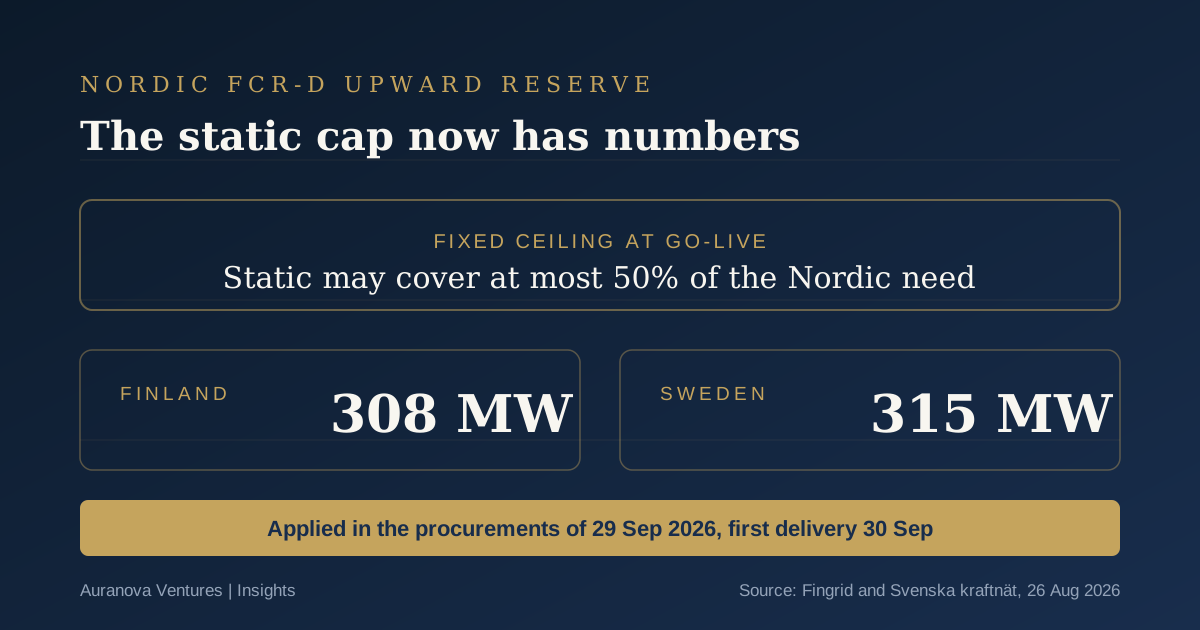
In early August we told readers to calendar one publication: the national quotas for the Nordic static FCR-D cap. FCR-D, frequency containment reserve for disturbances, is the reserve that catches a falling frequency when a large plant or cable trips; static is its simplified prequalification class. On 26 August Fingrid and Svenska kraftnät published them. The cap applies from the procurements of 29 September for first delivery on 30 September 2026. Finland may source up to 308 MW of the reserve from the static class. Sweden may source up to 315 MW. Similar numbers, different binding conditions.
The development
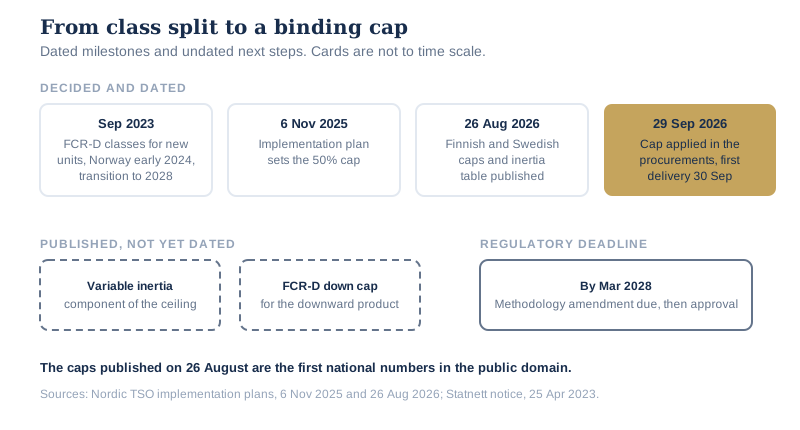
Prequalification, the technical testing that admits a resource to a reserve product, splits FCR-D into two classes under requirements in force since September 2023 in Sweden, Finland and Denmark and early 2024 in Norway, with transition for units already delivering FCR running as late as 2028. Dynamic FCR-D passes the full activation, deactivation and stability programme. Static FCR-D is the alternative regime for resources that cannot meet parts of it; both classes must deliver at least 86 per cent of their steady-state response within 7.5 seconds, so the split is about controllability, not raw speed. Relay-tripped consumption (demand disconnected by a protective relay) is the operators' own example of static provision; step-regulated units count as static too.
From the procurements of 29 September, the four Nordic transmission system operators (TSOs) will cap how much static FCR-D upward capacity they buy. The updated implementation plan makes three things concrete. First, go-live uses a fixed ceiling only: static capacity may cover at most 50 per cent of the total Nordic need, with the inertia-linked variable component that can push it lower still undated. Second, the Nordic ceiling is split into national caps, 308 MW for Finland and 315 MW for Sweden at go-live, reviewed quarterly. Third, pricing is unchanged: within each auction every accepted bid, static or dynamic, earns the same marginal price, the clearing price paid to all winners.
What it actually means
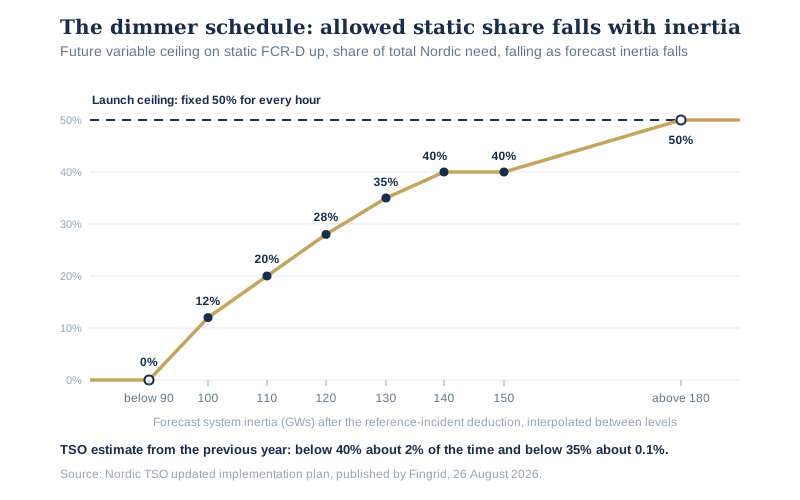
Inertia is the rotational energy stored in the grid's spinning machines, measured in gigawatt-seconds (GWs); it buys the system time when frequency falls. The published table wires the future ceiling to that quantity like a dimmer, not a switch: 50 per cent above 180 GWs, 40 at 150, 28 at 120, 12 at 100 and zero below 90, interpolated between levels. When it activates, a forecast of inertia (net of the possible loss from the reference incident) sets the dial for each market time unit, the traded delivery period. The TSOs estimate from last year's data that the ceiling would sit below 40 per cent about 2 per cent of the time and below 35 per cent around 0.1 per cent. The national arithmetic is where the caps diverge. Finland's 2026 obligation for FCR-D upward is 309 MW; its static cap is 308 MW, one megawatt below the whole national need. Fingrid expects the market impact in Finland to be limited. Sweden's maximum requirement is 547 MW when Oskarshamn 3 runs at full output, so a 315 MW cap covers at most 58 per cent of the requirement in those hours (our arithmetic). Against supply: on 1 July 2026 Sweden had about 420 MW of static FCR-D upward capacity prequalified, rounded to the nearest 10 MW, against 4,330 MW dynamic. That static book, the stock of prequalified static capacity, is about 105 MW larger than the Swedish cap. A prequalified megawatt is not an offered megawatt, so whether the cap actually binds is a question the first auctions will answer. The asymmetry the published numbers support is about binding conditions: Finland's cap can bind only if static bids cover nearly the whole need in an hour; Sweden's can bind while static covers just over half of one. Both yardsticks are obligations rather than auction denominators, since hourly procurement varies and up to a third of an obligation can be sourced across borders. We found no published Finnish static book, so a like-for-like comparison is not possible from public data.
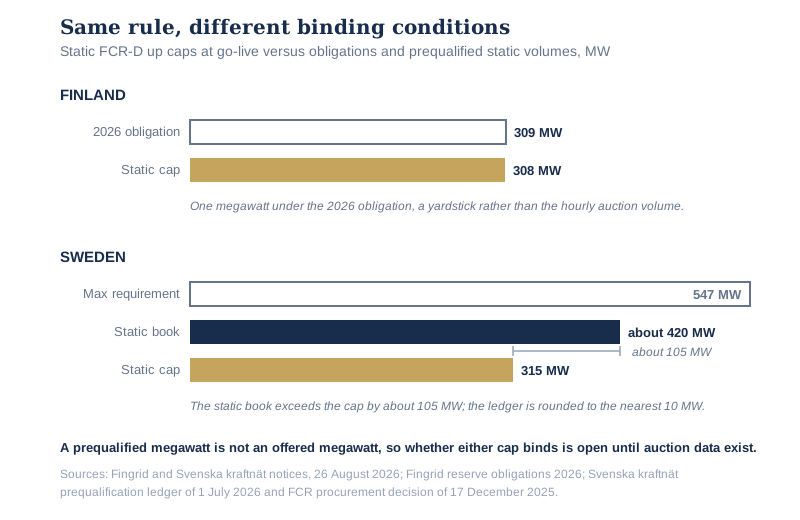
Why the asymmetry? A national cap is not half the national requirement. The Nordic ceiling is split by the FCR sharing keys, the agreed split of the Nordic obligation by each country's annual consumption and production, then adjusted by each TSO's reference value, built from its historical static supply with a margin for new prequalification. At the maximum Nordic requirement of 1,450 MW the 50 per cent ceiling is 725 MW; Finland and Sweden account for 623 MW, leaving roughly 100 MW with Statnett and Energinet, whose national figures the notices do not give. The reconciliation is our arithmetic and indicative only: the requirement moves with the dimensioning fault (the largest single failure the reserve is sized against) and excess allocation is reshared between TSOs when the caps are set.
When we build revenue stacks for Nordic batteries, this package changes the shape of the problem rather than today's cash flow. A battery prequalified dynamic is exempt from the quota and gains no promised uplift; it still competes on price with every dynamic megawatt in its zone. Fingrid's FCR terms valid from 30 September spell out the selection rule: when a static bid cannot be accepted because the minimum dynamic amount must be met, the next usable bid is selected and the most expensive accepted bid sets the hour's marginal price. Illustratively for Sweden: 300 MW of in-merit static offers (offers priced below the clearing level) in an hour leaves nothing constrained, 330 MW up to 15 MW and 420 MW up to about 105 MW, upper bounds, not forecasts. We model rejection and price effects as sensitivities, not base cases, until auction data exist. At go-live the fixed ceiling ignores inertia; when the variable component arrives, tightening concentrates in low-inertia hours and the price effect still depends on the bids behind it. The methodology behind the minimum dynamic share is due for amendment by March 2028, with regulatory approval to follow.
Who is affected and how differently
Owners of static capacity in Sweden carry the live risk. A book of about 420 MW against a 315 MW cap means acceptance risk now has a published ceiling, not a consultation scenario. Owners of static capacity in Finland have far more room for the reason above. Relay-tripped demand response is the operators' own static example, so utilities running such programmes should read the national numbers first. For policymakers the cap is the security trade made explicit: the lighter-tested class is rationed to keep the response the frequency needs in the mix.
For battery owners the quota cuts on class, not technology. We found no published split of battery fleets by class. Dynamic prequalification exempts the asset; the work is checking that the file actually says dynamic, especially for fleets qualified years ago behind coarse controls, then pricing the low-inertia sensitivity rather than booking it.
Aggregators with mixed fleets face a subtler question: reference values are built from historical static supply and reviewed quarterly, so sustained changes in static supply can move future caps. That is our inference from the reference-value design. The TSOs publish neither window nor sensitivity, so treat it as directional.
For investors the diligence line splits twice, by class and by country. A model that treats FCR-D as one Nordic line can hide materially different exposures on both.
What to do about it
First, confirm the class on every FCR-D prequalification file you own or underwrite before 29 September.
Second, for Swedish static portfolios, model acceptance against the 315 MW cap by hour, not with a flat haircut. Watch the quarterly reviews.
Third, for dynamic batteries, add a low-inertia price sensitivity to the FCR-D line and book no base-case uplift. The variable component's activation date is the trigger to revisit.
Fourth, if a static asset merits a controls retrofit and dynamic requalification, start now. A significant controls change triggers a full prequalification and the published Nordic process allows up to eight weeks to confirm completeness and up to three months to decide, with testing before any of it, so the clock can run months. The published caps let you price that retrofit against a published ceiling instead of a guess.
The number behind the number
This is the kind of question we at Auranova Ventures work through with developers and investors across the Nordics, Baltics and wider Europe. The caps, obligations and volumes above are the TSOs' figures; the reconciliation arithmetic and acceptance-risk framing are ours. In our revenue-stack work the FCR-D line now carries two live dimensions, class and country, with the inertia hour joining when the variable component activates. The Finland-Sweden contrast above is the clearest illustration yet of why one Nordic average misleads. If your model still prices FCR-D as one number, reply and we will show you how we would split it.
When the variable component switches on and the dimmer starts moving hour by hour, will your revenue model see it coming or read about it afterwards?
Sources
- Updated implementation plan for the volume limitation on static FCR-D upward regulation, Fingrid, 26 August 2026
- Begränsning ska säkerställa tillräcklig andel dynamisk FCR-D, Svenska kraftnät, 26 August 2026
- Volymbegransning for statisk FCR-D, Svenska kraftnät implementation page with the 315 MW Swedish cap
- Power system reserves with Fingrid's 2026 national reserve obligations and the 1,450 MW Nordic FCR-D up requirement
- Decision on FCR procurement volumes for 2026, Svenska kraftnät, 17 December 2025
- Prequalified reserve volumes as of 1 July 2026, Svenska kraftnät
- Implementation plan for the volume limitation on static FCR-D upward regulation, Fingrid, 6 November 2025
- Implementation of new technical requirements for FCR in the Nordics, Statnett, 25 April 2023
- Technical Requirements for Frequency Containment Reserve Provision in the Nordic Synchronous Area, version 1.1, Nordic TSOs, 28 March 2025
- Terms and conditions for providers of frequency containment reserves, valid from 30 September 2026, Fingrid