Fences, Firewalls and a 200 MW Cap: Finland Rewrites the Terms of Reserve Revenue
27 August 2026 · 8 min read · Auranova Ventures
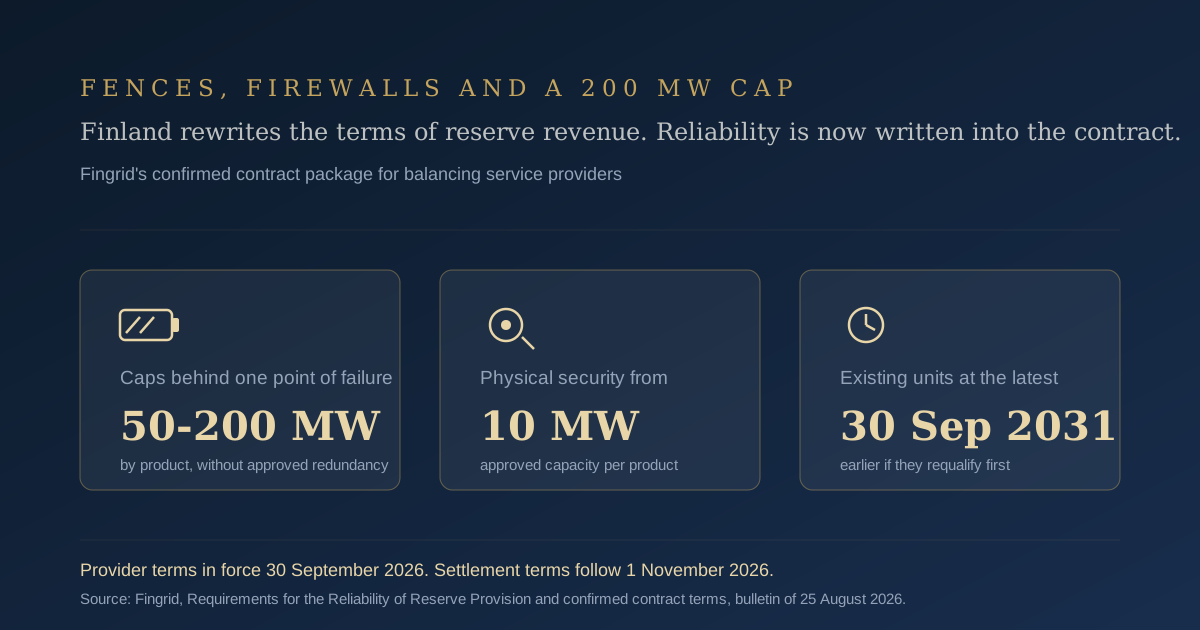
On 25 August Fingrid published the compilation of contract changes its regulator confirmed in July. From 30 September, a newly approved reserve unit in Finland meets a formal reliability rulebook: caps on how much reserve one fault may take down, a cyber baseline and, from 10 MW of approved capacity in a product, a monitored site. Units approved earlier meet it when they next requalify, by September 2031 at the latest. The rulebook does not reprice the auctions; it decides who may keep bidding.
The development
On 25 August 2026 Fingrid, Finland's transmission system operator, published the summary of confirmed changes to its reserve and balance service contracts. The package was consulted on between 13 May and 12 June 2025, submitted to the Energy Authority, Finland's energy regulator, on 10 November 2025 and confirmed in July 2026. On 30 September 2026 the updated aFRR, FCR, FFR and mFRR provider terms take effect, together with a new document, Requirements for the Reliability of Reserve Provision. On 1 November 2026 the updated imbalance settlement terms follow. Imbalance settlement settles each party's imbalance, the gap between its measured and its traded position; the new terms add a chapter on energy storage.
A balancing service provider (BSP) is the party that sells reserves to Fingrid. The five products span a ladder of speed: FFR, the fast frequency reserve, fully active in 0.7 to 1.3 seconds depending on the chosen trigger; FCR-N and FCR-D, the frequency containment reserves for normal operation and disturbances; aFRR, the automatic frequency restoration reserve that pulls frequency back to 50 hertz; and mFRR, the manual frequency restoration reserve activated on Fingrid's instruction. In the Finnish revenue stacks we model, the fast end of this ladder is where battery income concentrates, so this housekeeping concerns anyone who owns storage.
What it actually means
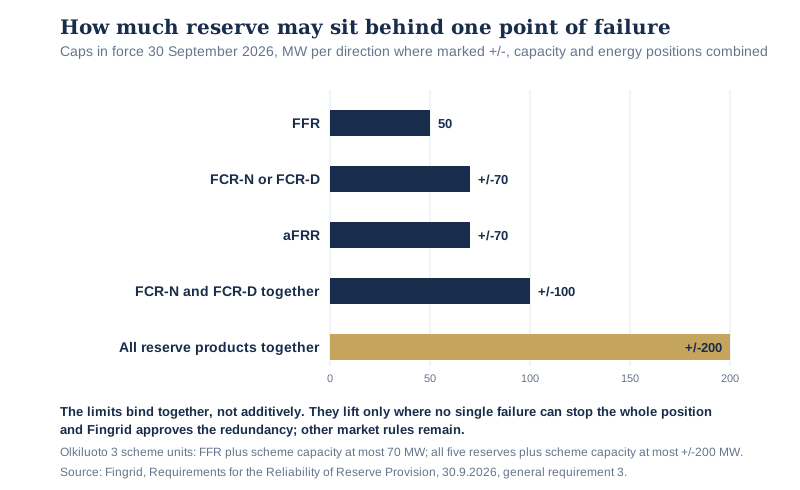
The reliability document writes resilience into market access. The core rule caps how much reserve may sit behind a single point of failure, meaning any one fault that could knock the whole position out: an electrical fault, a control system failure, a telecommunications outage. The caps: 50 MW of FFR; plus or minus 70 MW of FCR-N, of FCR-D or of aFRR; plus or minus 100 MW of the two FCR products together; plus or minus 200 MW across all five products. They count megawatts maintained in capacity markets (paid for holding reserve) and energy markets (paid for delivery) together. Units in the Olkiluoto 3 system protection scheme, the arrangement around Finland's largest generating unit, carry two further sums: FFR plus scheme capacity at most 70 MW; all five reserves plus scheme capacity at most plus or minus 200 MW. The caps lift only where no single failure can prevent the whole position from delivering and Fingrid has reviewed and approved the redundancy. Duplicating functions inside the same hardware does not qualify; for FCR and FFR even the grid connecting line must be redundant; for mFRR a phone call to the control room can be the fallback.
Our illustration, the caps Fingrid's: an 80 MW aFRR position in one direction behind a single unapproved failure point may maintain at most 70 MW; the last 10 MW cannot be offered until the architecture splits or the redundancy is approved. The caps demand nothing of a position below them, though other system rules can still apply.
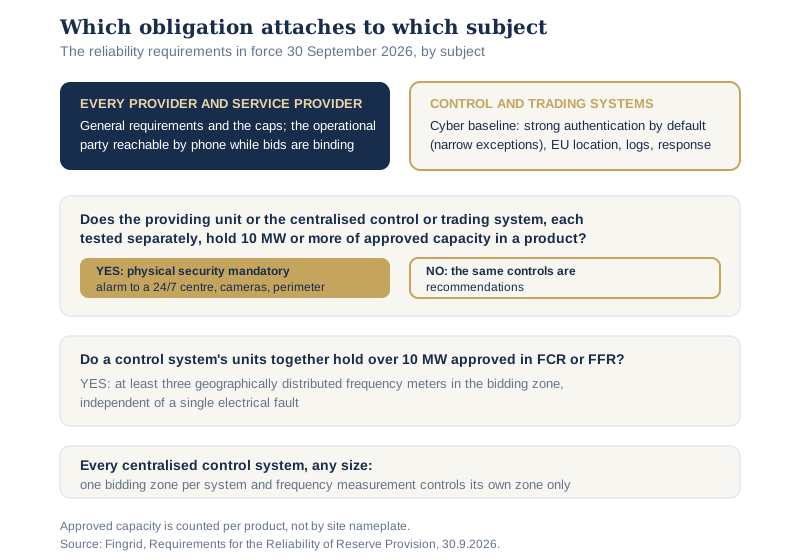
Around the caps sits a security regime. Centralised control and trading systems must sit inside the EU, keep logs at least six months, monitor critical services around the clock and maintain a documented incident response. Strong authentication is the default for every user, with narrow exceptions like compensating controls (a separate non-internet connection), emergency and monitoring accounts. Providing units and centralised control or trading systems with 10 MW or more of approved capacity in a product add mandatory physical security: an intruder alarm wired to a 24/7 security centre, all-entrance cameras with 30 day retention and annual testing, within a broader set spanning perimeter protection and window detection. Below 10 MW these are recommendations. Every centralised control system serves a single bidding zone (the price area a market clears over). A control system whose units' approved capacity in FCR or FFR together exceeds 10 MW needs at least three geographically distributed frequency meters.
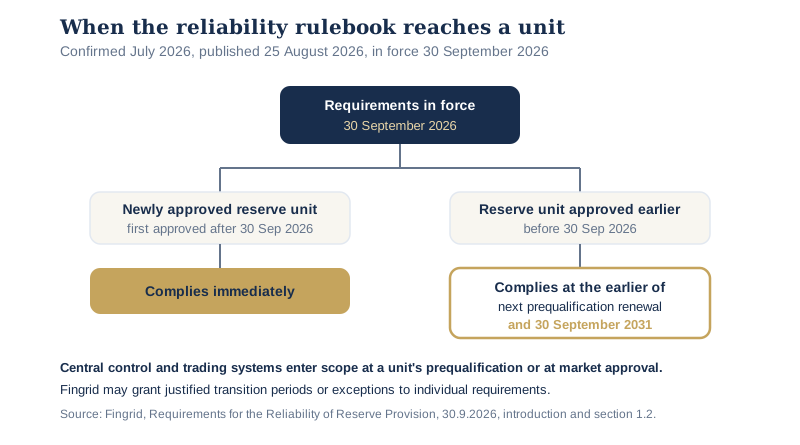
The clock: newly approved units comply from 30 September 2026; units approved earlier at the first of their next prequalification renewal (the periodic re-test a reserve unit passes to keep selling) and 30 September 2031. Central systems enter scope at a unit's prequalification or at market approval. Fingrid may grant justified transition periods.
Settlement reaches standalone storage first. From 1 November the confirmed terms register a storage facility as two metering points, consumption when charging and production when discharging, not netted within an imbalance settlement period, the 15 minute window the market settles over. Same-meter netting under a Government Decree and co-located and disturbance-only storage carry their own treatments. Both directions otherwise carry the volume fee on production and consumption, 0.40 euro per megawatt hour since 1 July 2026: by our arithmetic, charging and discharging one megawatt hour each books 0.80 euro in volume fees before losses. The small-scale production category ends; output under 1 MW settles like other production, still reported in aggregate, with backup and disturbance-only units nettable against consumption.
The consultation draft proposed raising the minimum collateral a balance responsible party posts (the BRP, the party financially answerable for its portfolio's imbalances) from 40,000 to 200,000 euro; the confirmed terms keep 40,000. The confirmed aFRR and mFRR terms also let Fingrid introduce elastic demand, procurement that limits how much balancing energy is bought according to price, in aFRR only above the dimensioned capacity need. Introduction requires at least one month's public notice and Fingrid will not adopt the model for now: shelved and kept.
Who is affected and how differently
The sceptic's reading is fair: Fingrid describes much of the package as clarifying practice already in force, the sanction for undelivered aFRR capacity stood in the 2025 terms and a fleet already redundant on a secured site may, on our read, see little new cost. What changes is consolidation. The caps, the security requirements and the five-year phase-in now sit in one contractual rulebook as conditions of market access a diligence team can test. Where an architecture fails them the cost is real; where it passes, the compliance file is evidence a lender can use.
For aggregators and optimisation platforms the questions are architectural: the caps bind at whatever their shared systems can take down. Developers whose units will hold 10 MW or more approved in a product inherit a security line, capital and running cost, to price before financial close. Investors and lenders get a new diligence chapter: whether the control chain behind the revenue survives an audit and what compliance costs at requalification. Utilities and BRPs meet the settlement changes plus a redefined compensation model between an independent aggregator (a party activating a customer's flexibility without being its supplier) and the BRP whose balance moves.
What to do about it
- Map every megawatt of reserve against the single point of failure caps and calendar each unit's requalification date. New entries answer by 30 September; qualified fleets by the earlier of requalification and September 2031.
- Price the security line for anything at or above 10 MW of approved capacity per product: alarms, cameras, monitoring and annual testing.
- Send your optimiser a short questionnaire: system locations, frequency meter count, approved redundancy and incident response. A platform that cannot answer quickly is itself a finding.
- Stress-test the revenue stack against an illustrative elastic demand scenario with assumed price cut-offs, since Fingrid has published no parameters.
The read that matters
Finland's reserve auctions still set the price of a megawatt. What the confirmed terms set is what it takes to keep a megawatt eligible and where that carries a bill. This is the kind of question we at Auranova Ventures work through with developers and investors across the Nordics, Baltics and wider Europe: the rules above are Fingrid's, the read on what they do to a specific fleet is ours. If you hold or are buying Finnish reserve exposure, reply and we will walk your architecture through the new rulebook.
Which is worth more in your Finnish portfolio next year: another megawatt of capacity or the redundancy file that lets the megawatts you have keep bidding?
Sources
Fingrid publishes its contract documents in Finnish with unofficial English translations. The English versions are cited here; where wording is decisive the Finnish originals govern, for example the reliability requirements (https://www.fingrid.fi/globalassets/dokumentit/fi/sahkomarkkinat/reservit/reservien-toimitusvarmuusvaatimukset-30.9.2026.pdf) and the aFRR terms (https://www.fingrid.fi/globalassets/dokumentit/fi/sahkomarkkinat/reservit/liite-1-afrr-ehdot-30.9.2026.pdf), whose Finnish text resolves a product-name slip in the English elastic demand clause.
- Fingrid, Contract updates to balancing service providers and balance responsible parties in autumn 2026 (25 August 2026): https://www.fingrid.fi/en/news/news/2026/contract-updates-to-balancing-service-providers-and-balance-responsible-parties-in-autumn-2026/
- Fingrid, Requirements for the Reliability of Reserve Provision, in force 30 September 2026: https://www.fingrid.fi/globalassets/dokumentit/en/electricity-market/reserves/requirements-for-the-reliability-of-reserve-provision-30.9.2026.pdf
- Fingrid, General terms and conditions concerning imbalance settlement, valid from 1 November 2026: https://www.fingrid.fi/globalassets/dokumentit/en/electricity-market/reserves/valid-from-01.11.2026-fingrid-oyj-general-terms-and-conditions-concerning-imbalance-settlement.pdf
- Fingrid, Terms and conditions for providers of automatic Frequency Restoration Reserves (aFRR), 30 September 2026: https://www.fingrid.fi/globalassets/dokumentit/en/electricity-market/reserves/terms-and-conditions-for-providers-of-automatic-frequency-restoration-reserve-30.9.2026.pdf
- Fingrid, Terms and conditions for providers of aFRR, valid from 5 June 2025 (prior version): https://www.fingrid.fi/globalassets/dokumentit/en/electricity-market/reserves/attachment-1-terms-and-conditions-for-providers-of-automatic-frequency-restoration-reserves-afrr-valid-from-5.6.2025.pdf
- Fingrid, Terms and conditions for providers of manual Frequency Restoration Reserve (mFRR), 30 September 2026: https://www.fingrid.fi/globalassets/dokumentit/en/electricity-market/reserves/terms-and-conditions-for-providers-of-manual-frequency-restoration-reserve-30.9.2026.pdf
- Fingrid, Appendix 2 to the Balance Agreement, fee components and determination of fees, 30 September 2026: https://www.fingrid.fi/globalassets/dokumentit/en/electricity-market/reserves/valid-from-30.09.2026-appendix-2-fee-components-and-determination-of-fees.pdf
- Fingrid, balance service fee table: https://www.fingrid.fi/en/electricity-market/balance-service/fees/
- Fingrid, FFR product page (activation times): https://www.fingrid.fi/en/electricity-market/reserves/reserve-products/fast-frequency-reserve-ffr/
- Fingrid, Energy Authority confirms terms for the 15 minute imbalance settlement period (2023): https://www.fingrid.fi/en/news/news/2023/energy-authority-confirms-changes-to-the-terms-and-conditions-for-balance-responsible-parties-and-balancing-service-providers-in-relation-to-the-15-minute-imbalance-settlement-period/
- Fingrid, Consultation on changes to the terms and conditions of Reserve Suppliers and Balance Responsible Parties 05/2025 (13 May 2025), with background document: https://www.fingrid.fi/en/news/news/2025/consultation-on-changes-to-the-terms-and-conditions-of-reserve-suppliers-and-balance-responsible-parties-052025/
- Fingrid, Changes to Balancing Service Providers and Balance Responsible Parties 11/2025, summary (21 November 2025): https://www.fingrid.fi/en/news/news/2025/changes-to-balancing-service-providers-and-balance-responsible-parties-112025---summary/