The Danube Stress Test: One Drought, Two Battery Fleets, Two Price Outcomes
11 August 2026 · 9 min read · Auranova Ventures
On the morning of 28 July 2026, Nuclearelectrica disconnected Unit 1 of the Cernavoda nuclear plant from the Romanian grid. The Danube, whose water condenses the plant's steam, had fallen to a level the operator called unprecedented. Within a week evening wholesale prices across Southeast Europe spiked to 717 euro per MWh. Romania's batteries pushed roughly 600 MW into the peak; Bulgaria, running the world's biggest battery fleet relative to system size, cleared among the region's lowest prices. The battery era just sat a drought exam.
The development
Unit 1, a roughly 700 MW reactor, had been back just 23 days from a planned outage, reconnected on 5 July. On 27 July Nuclearelectrica filed a current report with the Bucharest Stock Exchange announcing a controlled shutdown the next morning, citing the Danube's unprecedented low and forecasts from INHGA, Romania's hydrology institute. A second filing on 29 July confirmed Unit 1 safely down and queued Unit 2 for the same treatment; after an overnight assessment the operator instead kept Unit 2 connected. By early August the company was importing electricity from Ukraine via Moldova's Energocom, per statements reported on 3 August. The 30 July filing leaves Unit 1 "safely shut down until the Danube's water level allows the safe reconnection"; as of 11 August no reconnection release had been published.
Balkan Green Energy News' analysis of day-ahead exchange data across seven Southeast European markets for 31 July to 6 August found prices 50 to 100 per cent above the weeks before, spikes concentrated between 19:30 and 20:30 on 3 and 4 August and a peak of 717 euro per MWh in one 15-minute interval on Slovenia's exchange. The day-ahead market is the auction pricing power for each 15-minute interval of the next day. The same drought squeezed supply beyond Cernavoda: Hungary's Paks plant cut Unit 1 by 254 MW from the evening of 27 July to keep the water it returns to the river inside temperature limits, per the operator's notice.
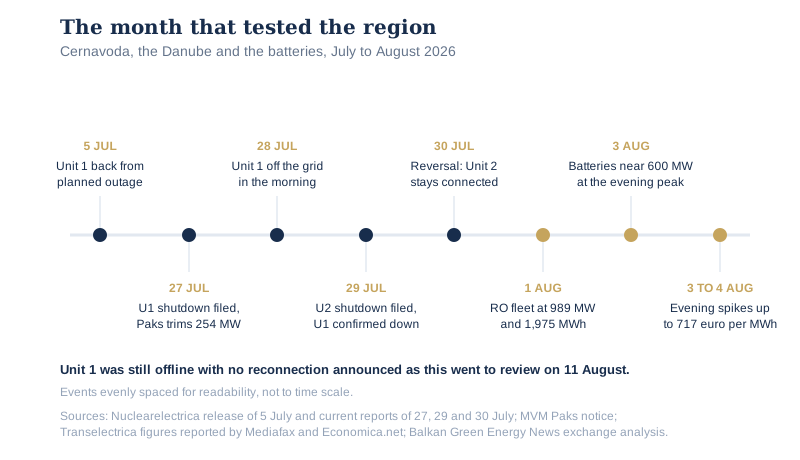
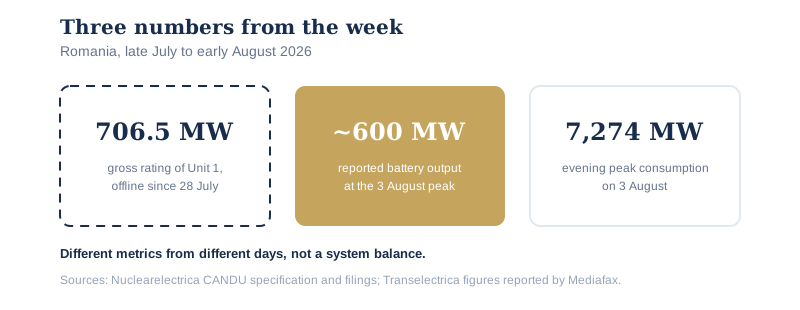
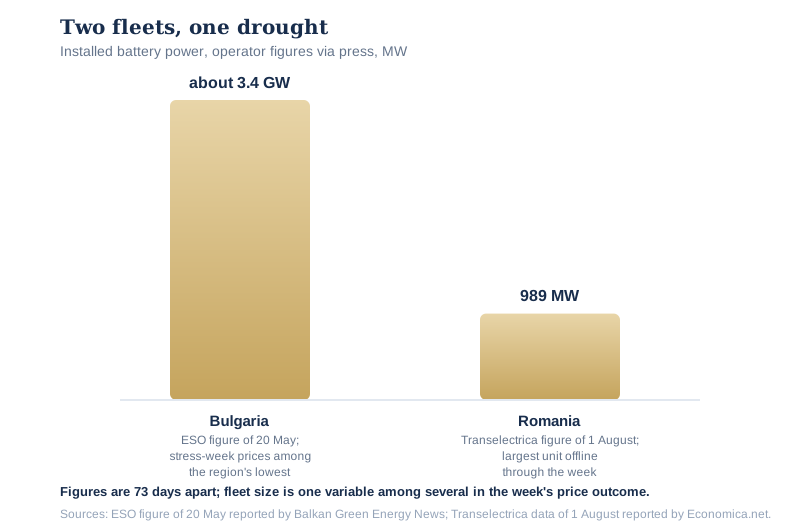
At the 3 August evening peak, with consumption at 7,274 MW, Romania's batteries delivered about 600 MW, per Transelectrica figures reported by Mediafax. The fleet stood at 989 MW of power and 1,975 MWh of storable energy on 1 August, per Transelectrica data reported by Economica.net. Bulgaria went into the summer with about 3.4 GW online as of 20 May, per figures from its transmission operator ESO, about 16 per cent of the installed power base and the world's highest share on that reporting; the same outlet's stress-week analysis put the fleet near 3.7 GW. That analysis found Bulgaria and Greece consistently cheapest and credits their solar plus battery fleets.
What it actually means
This is a lesson about correlated availability, with an asterisk. Cernavoda and Paks sit on the same river; the shrunken Danube constrained both inside a week, intake level at one, returned-water temperature at the other. That is a common-mode failure, one shared cause hitting several assets at once; it lands on firm capacity, the ability to deliver when the system needs it most. The asterisk is Kozloduy, Bulgaria's own Danube nuclear plant, which reported both units running to schedule on 31 July, mid-event, its water drawn through an intake built in a deep river bay. Exposure is site engineering, not geography. Still, when the water fell, some firm megawatts turned out to be conditional.
A battery's fuel is different: it can charge on the midday solar surplus, which this drought left intact. The spike hours, 19:30 to 20:30, are the evening ramp, the window where solar exits while demand holds; whoever shifts midday energy into it gets paid the difference. That shift is arbitrage; a drought widens the spread precisely when river-cooled plant is least able to compete. A battery is firm only as long as its charge lasts, a two-hour battery is a two-hour promise, but this drought constrained river-cooled plant, not charging energy.
Bulgaria and Romania are an imperfect comparison, not a controlled experiment. Bulgaria also carries about 6 GW of solar per the same analysis; Greece, with 9 GW of solar and only about 1 GW of batteries, cleared cheap too, so solar did much of the work; demand, interconnection and the rest of each mix moved too. What the exchange data supports is narrower: the markets built on solar plus flexibility rode the drought week at the region's lowest prices while systems leaning on river-cooled plant spiked. Our reading, a hypothesis not a proof, is that stored midday solar competing into the evening ramp is what a fleet at Bulgarian scale adds. Romania's fleet, at about three fifths of its rated power into the peak, was not big enough to do the same. The price figures are the exchange analysis, the fleet figures are the operators' own and the hypothesis connecting them is ours.
The second reading belongs in every model. A battery fleet big enough to flatten a scarcity evening is big enough to compress the spread that pays batteries. When we model revenue stacks, the layered income mix a battery earns across markets, we treat the share of annual arbitrage revenue carried by the few extreme weeks as an output to measure rather than an assumption, large enough to move an equity case. Fleet growth clips exactly those weeks first. We watched saturation compress prices in the Nordic frequency reserves, the fast grid-stability products batteries sell there; different products, same crowd dynamics.
Who is affected and how differently
Developers in Romania are building into demonstrated need. The 1 July compilation by ANRE, Romania's energy regulator, counts 40 storage-fitted and standalone-storage projects, 3,143 MW of maximum approved export power, reported as due for commissioning during 2026. Approved export power is not installed battery power and dates slip, but each cohort makes the system safer and the spread thinner. The week of 3 August makes a stronger case for Romanian storage than any pitch deck; it is also a spread the arriving fleet will make rarer.
For investors, Romania is where scarcity still prices: a fleet under 1 GW, a 700 MW unit offline and imports arranged via Moldova's Energocom. Bulgaria is where saturation is likely to show first: whatever mix of solar, interconnection and storage held its prices down in the crisis will bear on an arbitrage case in normal weeks too. UK developer Alcemi was reported on 30 July to have taken majority stakes in 575 MW and 2,300 MWh of Romanian projects, terms undisclosed; the direction of that entry matches the asymmetry.
Utilities holding water-cooled portfolios just watched firm capacity become conditional on a river gauge or the depth of an intake bay. In our diligence, drought exposure now sits in the availability assumptions, not a climate appendix; batteries hedge it at portfolio level, within the hours their duration buys.
Policymakers got two demonstrations at once. Bulgaria's build-out, helped along by the EU-funded RESTORE programme we covered when the awards landed, quietly did for the evening peak what emergency imports do loudly. Romania has the tools moving: connection auctions for projects of 5 MW and above under ANRE Order 53/2024 took legal effect on 1 January, first-round requests closing 14 July. The European Commission approved a 150 million euro scheme on 6 March for at least 2,174 MWh of new standalone storage. The first week of August is the argument for finishing that agenda.
What to do about it
First, put the week of 31 July to 6 August into your revenue model as a named scenario and check its share of modelled annual arbitrage revenue. If the share is large, your base case depends on scarcity weeks recurring; say so rather than burying it in an annual average.
Second, in Romania, price your project against the 2026 commissioning cohort: the August spread was set by a fleet under 1 GW, while ANRE's 2026 pipeline carries 3,143 MW of approved export power. Underwrite the entry year and the year after, not the crisis week.
Third, in Bulgaria, underwrite the full stack rather than the energy spread alone. A fleet that flattens crisis evenings is telling you where pure arbitrage is heading; balancing services (the reserves a grid operator buys to keep supply and demand matched), contracts that pay for availability rather than energy and portfolio deals with thermal or hydro owners are where durable value sits.
Fourth, wherever you hold thermal or hydro exposure, map which of your megawatts share a river and price that correlation; faults do not always arrive independently. A storage allocation, sized in hours as well as megawatts, hedges the repeat.
The exam repeats
The river will recover and Unit 1 will reconnect. The exposure this month revealed will not go with it. This is the kind of question we at Auranova Ventures work through with developers and investors across the Nordics, Baltics and wider Europe. When we model a revenue stack for Romania or Bulgaria, the scarcity-week distribution is an explicit input, not a footnote. If you are underwriting storage in the region, reply and we will stress your case against both futures, the drought that repeats and the fleet that arrives.
Does your revenue model contain a week like the first week of August or only the average of fifty-two of them?
Sources
- Current report on the controlled shutdown of Unit 1, Nuclearelectrica filing with the Bucharest Stock Exchange, 27 July 2026
- Current report on the planned shutdown of Unit 2, confirming Unit 1 safely shut down, Nuclearelectrica, 29 July 2026
- Current report confirming Unit 2 remains connected, Nuclearelectrica, 30 July 2026
- Reconnection of Unit 1 of the Cernavoda Nuclear Power Plant to the National Power Grid, Nuclearelectrica, 5 July 2026
- Notice on power reduction at Paks Unit 1 due to Danube conditions, MVM Paks, 27 July 2026
- Statement on normal operation during low Danube levels, Kozloduy NPP, 31 July 2026
- Heatwave pushes power prices past EUR 700 in Southeast Europe, Balkan Green Energy News analysis of exchange data, 7 August 2026
- Bulgaria surges to world's No. 1 in battery systems share, ESO and ENTSO-E figures reported by Balkan Green Energy News, 26 May 2026
- Romania's storage capacity reaches 2,000 MWh, Transelectrica data reported by Economica.net, 4 August 2026
- Capacity of Romania's battery power storage hits 2,000 MWh, with the 3 August peak contribution, Romania Insider, 5 August 2026
- Romania's Nuclearelectrica imports electricity from Ukraine as low Danube levels disrupt nuclear output, Romania Insider, 3 August 2026
- Information note on renewable projects with approved export power of 1 MW or more, ANRE, data as of 1 July 2026
- Grid capacity allocation process under ANRE Order 53/2024, with the 1 to 14 July 2026 allocation session, Transelectrica
- Commission approves a 150 million euro Romanian state-aid scheme for standalone battery storage, European Commission Representation in Romania, 6 March 2026
- Central and Eastern Europe: UK's Alcemi buys 2.3GWh Romania projects, Energy-Storage.news, 30 July 2026
- CANDU technology page with Unit 1 and Unit 2 gross ratings and condenser cooling description, Nuclearelectrica
- Bulgaria RESTORE: the subsidy that built a fleet, Auranova Ventures, July 2026